

The roads carry two kinds of machine. Crawlers, the working end, stamped-steel hulls on wheels and treads, riveted plate, engines you fix with hands, the caravan haulers of the Ribbon and the freight beasts of the gate yards. And hover, the money end, because a hover drive is a Relic core, pre-Fall propulsion nobody alive can manufacture, a hand-built hull around an heirloom heart, the deck pattern at vehicle scale. Ground is class and hover is claim, altitude is a statement, and every garage that can keep either running is a seat somebody holds or somebody wants.
Get this into your head early, because every scam in this city runs on you not knowing it, there are two kinds of technology in the Everwinter, and only one of them can be made.
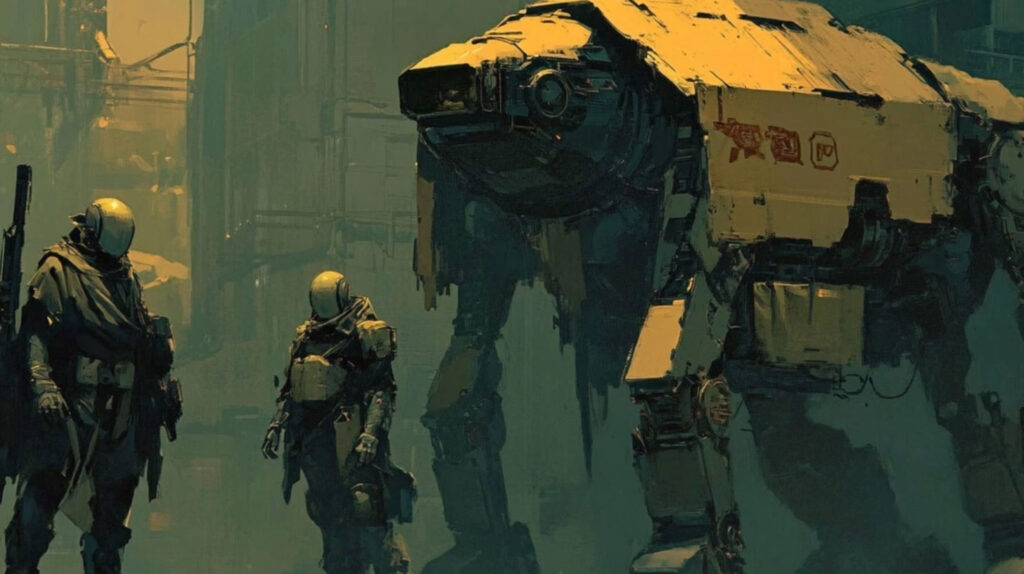
Rustcraft is what the Bastion can actually build. Coax and solder, CRT glass, stamped receivers, hydraulic chrome with visible seams, anything you can machine on a founding-era lathe with founding-era steel. Rustcraft is heavy, loud, ugly, and honest. Break it and a wrench jockey fixes it by Thursday. It’s the living technology of this world, and it will outlast us all.
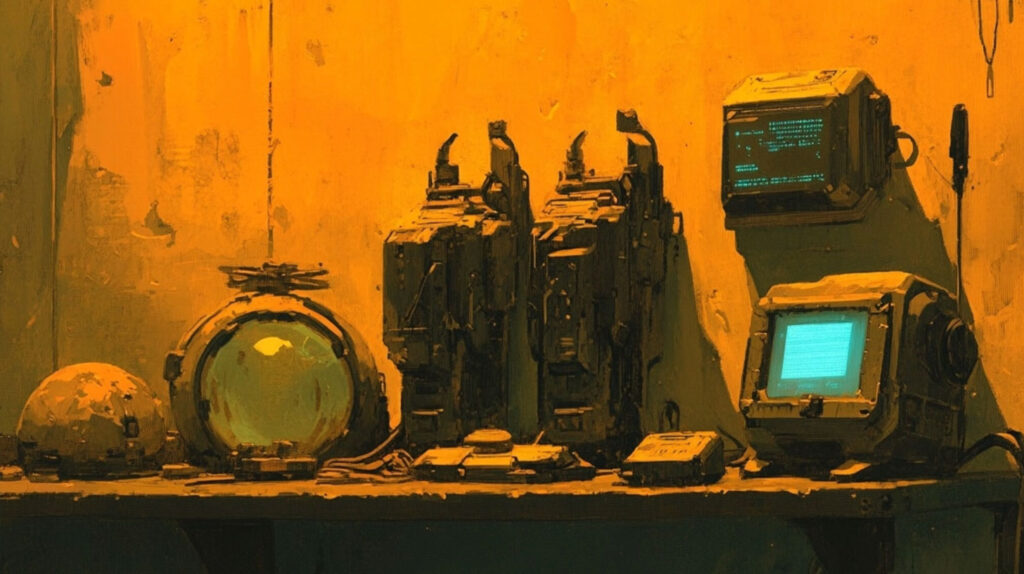
Relics are everything else. The pre-Fall super-science, cryo-pods, neural interface ports, holo-emitters, full-body prosthesis chassis, the Grid’s core stacks, every polished wonder the Corpos advertise. Nobody alive can manufacture a Relic. Nobody. The fabrication chains died with the old world, and what remains is a fixed and shrinking supply that can be maintained, refurbished, cannibalized, and inherited, but never replaced. Every neural port in this city was made before the snow. Read that again.
There’s a reason the founders built 1970 instead of rebuilding what fell, and it’s not poverty. Delicate machines die out here; valves run hot in cold rooms, linkages work at forty below, stamped steel can be fixed at any bench. That’s the reason the wrench jockeys give. The older reason is quieter, the smarter a machine, the better it hears, and the Static gets into anything built to listen. Analog is deaf. A CRT can’t be whispered to. The Bastion was built deaf on purpose, and a machine too simple to listen is the only machine that stays yours.
Which means every Relic has a history, and most of that history is a corpse. Ports are pulled at the Render; that’s where your “new” jack came from, and the polite word for the trade is reclamation. Chrome is heirloom now. Provenance papers travel with high-end augments like pedigrees, and a ripperdoc worth their license reads the papers before they read the hardware.
And here is where the wrench-jockey talk stops and the other talk starts, so decide now if you want to keep reading.
You know what an Echo is. A moment burned into an object by intensity of use. Now consider what a neural port is, an object whose entire job is intensity of use, worn inside a skull for a lifetime. Heavily used Relics saturate. The trade word is furnished. A furnished port carries residue of its previous tenant, phantom habits at first, your new hand reaching for a cigarette you never smoked, a taste for a street you’ve never walked. Dream bleed, in the middle weight. And in the rare, expensive, whispered-about cases, a full tenant, a jack that still remembers being someone.
Unfurnished units cost more. Obviously. A port with three previous tenants comes at a discount, and now you know why, and now you also know why some buyers pay a premium for furnished stock, specific furnished stock, a named arm, a particular jack, and you know what grief looks like when it has money. You don’t ask those people questions.
Mnemonics read residue for the provenance trade. If you’re buying serious chrome, pay for the read. The seam you can see is never the problem. The tenant you can’t is.
Now the practical religion of wearing the stuff, because chrome isn’t a purchase, it’s a relationship, and the city has built a whole liturgy around it.

The nine kinds. The street sorts chrome by what it does to you, and the catalog runs nine deep, neural for the mind and the wire, reflex for the hands, dermal for taking a hit, optic for seeing what you shouldn’t, combat for ending arguments, cardio for the long run, social for the room, economic for the ledger, and temporal, the strange ninth family, for the ones who want the clock itself to bend a little. Every kind runs in tiers, street grade to the pieces with waiting lists, and your tier is read off you as plainly as your boots.
The lifecycle. Bought chrome isn’t worn chrome. A piece travels in a box until a ripperdoc seats it, and carrying your own arm through Sputnik in a case is a rite everyone performs once and nobody forgets. In Sputnik the seating happens at the Spinal Tap, which is exactly what it sounds like and better than it smells. In Rust, the Fractured Point patches you cheaper and asks less. And once it’s in you, the real relationship starts, because chrome wears. Integrity is the word and biography is the meaning, a fresh piece runs true, a worn one flickers, and a neglected one fails you at the worst hour it can find, because that’s what neglected things do. The flicker is a language the whole street reads. An optic that stutters when its owner is tired says career. A hand that has started missing says broke, or hunted, or both.
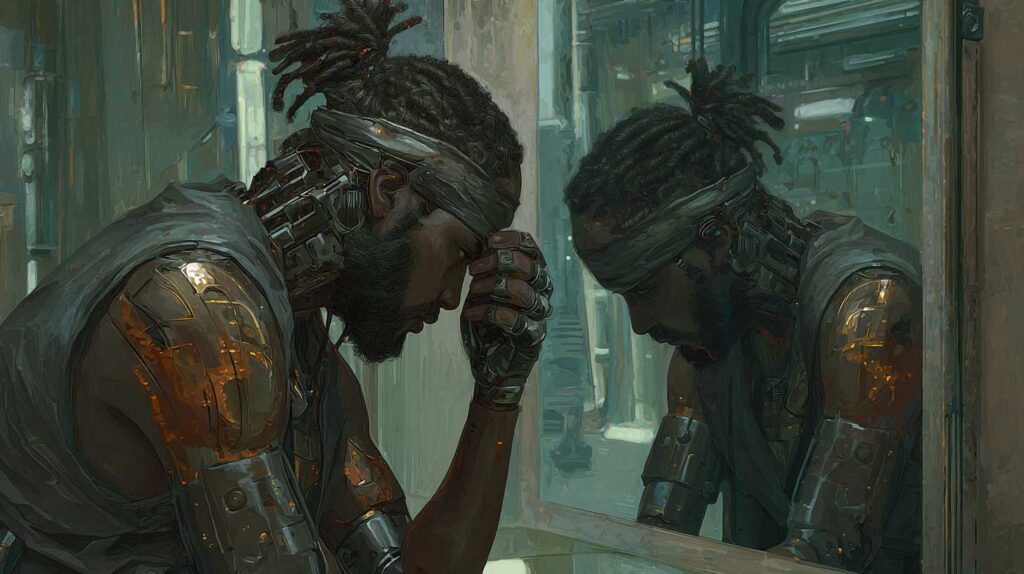
The maintenance. Rust N Relays keeps half of Sputnik’s chrome running, and the wrench jockeys there will tell you the one truth of the trade for free, maintenance is rent on your own body, and the residents who skip it are the ones the Render meets early. You dress the seam at Shadow Stitch, where the racks are cut for bodies with hardware in them, and dressing it well isn’t vanity, it’s information control.
The named loadouts. Run enough chrome in one direction and the street has a name for what you have become. The Blight Walker, stacked to shrug the amber, who works the hot zones the clean can’t enter. The Ghost, built for not being seen and not being remembered. The Tank, who has decided that the answer to this world is armor, all of it. The Wealth Engine, chromed for the ledger itself. The Social Engineer, whose augments all point at the room. These aren’t classes and nobody issues them; they’re what the street calls you when your choices become visible, which in this city they always do.
And the deep catalog. One family of chrome doesn’t get discussed at the counter. Pieces exist, Relic-class, rare, papered in ways that don’t survive scrutiny, that stop resisting the amber and start metabolizing it, hardware that turns accumulated Blight into something the body can use, armor, endurance, worse words, and that only wakes past the third stage of conversion. The trade won’t confirm these pieces exist. The Ascendancy quotes their spec sheets like scripture. Draw your own map of what that means, and of who is buying.
[TRANSMISSION END]